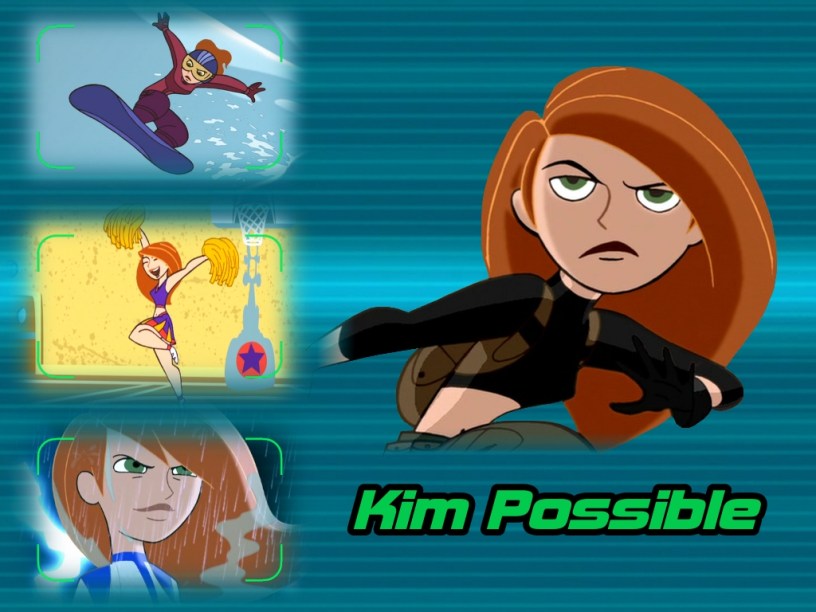
What’s the sitch? That famous line originates with Disney Channel’s red- headed heroine, Kim Possible. Kim Possible is an animated action-comedy-adventure cartoon created by Bob Schooley and Mark McCorkle that aired on Disney Channel on June 7th, 2002, to September 7th, 2007. Like the title suggest, the show centers on Kim Possible—a high school cheerleader that fights crime using her cheerleading skills. She is accompanied by her klutzy best friend and sidekick Ron Stoppable with his pet naked mole rat Rufus. Kim is assigned her missions through Wade, a 10-year-old computer genius. While Team Possible battle supervillains, Kim and Ron live through modern day personal and social issues. The television series is aimed at both boys and girls from ages 9 to 14 and successfully appeals to this audience. The cartoon’s female lead and action, adventure, and comedy genres engage both genders. The show’s theme song perfectly demonstrates these and combines effective rhetorical strategies that captivate its audience. Kim Possible’s opening contains mainly pathos and ethos appeals. Besides the actual show, Kim Possible’s catchy theme songs captivate, entertain, and persuade its audience through the content presented.
Before the episode begins, the mesmerizing theme song, “Call Me, Beep Me” lures in boys and girls. For instance, the intro’s melody derives from pop music. The electric beats and sounds compose its catchy rhythm. Regardless of gender, pop culture is popular among the young crowd. Thus, it captures children including adolescents. In fact, “Call Me, Beep Me” became so beloved that its fans downloaded the tune as their ringtones. The music of this opening applies a pathetic appeal because it compels the viewer to feel energized and upbeat like the song. In addition, the song’s lyrics engage its viewer. The repetitive rhyming phrase, “Call me, beep me, if ya wanna reach me” practically engrave into its viewers’ brain. This literary device is commonly practiced in advertisements because the message will remain in the forefront of the audience’s minds. This also represents the effect of pathos because the catchy phrase promotes enthusiasm and joy to its listeners. The audience is not annoyed because the verse occurs in the right proportions. Ultimately, the first theme song attracts its crowd through the music and lyrics.
Besides the intro’s lyrics and tune, the theme song incorporates other important aspects that appeal to both genders. Immediately within the first few seconds, Kim is seen doing something epic. She front handsprings away from green lasers blasting at her then lands in a fighting stance. The quick scene’s purpose is to bait a boy audience since society generally guides males to pursue manly-action entertainment. As a result, these young men are likely to watch Kim Possible because it implies crime fighting and other boy relate interest. Additionally, this pathetic approach stimulates excitement. After Kim performs a parkour stunt, the activity of moving rapidly through obstacles by running, jumping, and climbing, the scene shifts to her cheerleading. She raises her yellow pom poms in her pretty purple cheerleading outfit with her teammates cheering in the background. The opening now directs its material to the young female audience. As for girls, society influences them to pursue feminine hobbies. These stereotypical hobbies are identified as feminine when females predominately practice these activities, like fingernail painting or tea parties. Consequently, it is probable girls will watch the television show. A few seconds past Kim cheerleading, specifically at 13 seconds, the theme song transitions to Ron. Ron aims his hair dryer grappler gadget to the top of a building, but the black zip line to the grappler is attached to his pants. When Ron fires his tool, his shorts fly off and he yells out of embarrassment while covering his underwear. Humorous scenes, such as the following, appeal to both boys and girls. The scenario’s innocent comedy is what children would smirk and laugh at. Overall, Kim Possible provides a balance between appealing to its male and female watchers.
Another powerful effect the theme song formulates is it persuades its audience to rethink and defy gender stereotypes. At 31 seconds in the opening, Kim Possible is flipping through a restaurant in her cheerleading outfit while one of her supervillains, Shego tries to attack her. This moment exemplifies to children that girls can fight crime and simultaneously look beautiful doing it. Truly, the entire theme song conveys women are capable of combat and battle like men. Since the cartoon captivates children’s interest through pathos, children may be convinced to believe its message. Moreover, the theme song demonstrates Ron as the damsel in distress. At 37 seconds, Kim rushes to Ron’s aid in her rocket roller-skates. He cries out her name as a giant robot almost crushes him. Clearly, the show is stating women do not need all the rescuing because men need saving too. Once again, the series achieves to depict its point.
Although Kim Possible’s introduction lacks logical appeals, it incorporates an ethical appeal to persuade its watchers. Kim Possible displays credibility by the Disney Channel wordmark logo located in the lower right corner. Throughout the theme song, the wordmark appears notifying television watchers they are viewing a Disney Channel program. The wordmark establishes credibility because Disney Channel is an honest and trusted source. The station is known for family-friendly content. This helps deliver the cartoon’s message to children because now its audience sees the series as trustworthy; the viewers are easier to convince because the source is reliable. In regards to logos, logical appeals are not present in the introduction. Logical appeals use scientific data and statistics to persuade people. This theme song excludes scientific information because it is highly probable the audience’s attention will disengage and leave. The objective of a theme song is to capture its audience emotionally so they will watch the show. Since children and adolescents compose the main viewers, it is risky for the theme song to include logical appeals. When this crowd goes to Disney Channel, they are expecting entertainment, not scientific research.
In general, the intro utilizes its music, lyrics, action, character designs, and comedy through pathos to intrigue and persuade its audience. The theme song even institutes credibility by Disney Channel’s wordmark. This as well convinces viewers to accept the messages Kim Possible broadcast. As for logos, the introduction does not exhibit any forms of a logical appeal because this eliminates the children audience. Since this is a theme song, it strictly applies pathos to gain children. The main goal is to motivate children to watch the actual show so it can teach children valuable life lessons. Kim Possible airs on a child and adolescent station because the cartoon’s creators know these age groups are impressionable. They want children to use their power for good in order to construct a safer community in life. Therefore, the television series uses its power for the good of the community.
Citations
“Industry Statistics.” MyRWA : Public Landing Page. N.p., n.d. Web. 08 Dec. 2016.
“Welcome to the Purdue OWL.” Purdue OWL: The Rhetorical Situation. N.p., n.d. Web. 08 Dec. 2016.
“University Writing Center – Rhetorical Analysis.” University Writing Center – Rhetorical Analysis. N.p., n.d. Web. 08 Dec. 2016.
“Kim Possible(TV Series 2002-2007).” IMDb. IMDb.com, n.d. Web. 08 Dec. 2016.


I like where it is going so far. From what you told me, you have everything structured very well. Nothing to say here hahaha xD
LikeLike
For your thesis, dont put “through” just put “real life obstacles”
LikeLike
Writing Styles-
>High – Strictly formal. No first person allowed whats so ever. Contains more definitions.
>Middle-Blog. Contains some slangs. Give own opinion.
>Low-Slang; improper speech.
In this essay, class is allowed to use High or Middle language.
My Style:
I am attempting to sound “High” for this rhetorical essay. So far, I only have my introduction. My introduction does not include too specific details and definitions. I mention the words pathos and ethos in the introduction, but I did not explain the definition of the terms. “The television show uses these elements through effective rhetoric advertisement techniques, and the rhetoric appeals pathos and ethos to gain its audience.” This sentence voice may in between High and Medium.
LikeLike
Note:
Focus on an episode, not the whole show.
LikeLike
Conclusion-
Explain what the author wants us (audience) to do. What’s the author’s ultimate goal?
LikeLike