
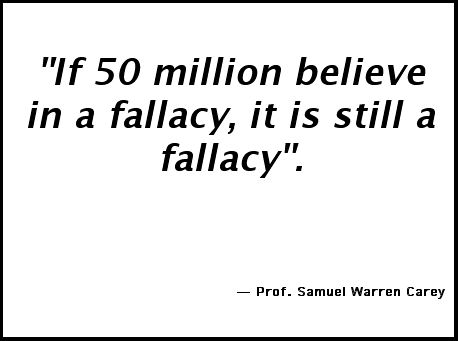
Quick Write
What is a fallacy? What ones are you familiar with?
Intro to Fallacies
Your textbook has a good list of fallacies beginning on page 352. This is a good place to start researching for your fallacy project. More details will be provided on Monday.
Here is an example of a fallacy used to persuade.
Key Terms
- Argument: A conclusion together with the premises that support it.
- Premise: A reason offered as support for another claim.
- Conclusion: A claim that is supported by a premise.
- Valid: An argument whose premises genuinely support its conclusion.
- Unsound: An argument that has at least one false premise.
- Fallacy: An argument that relies upon faulty reasoning.
- Booby-trap: An argument that, while not a fallacy itself, might lead an inattentive reader to commit a fallacy.
The Internet Encyclopedia of Philosophy – Fallacies
This is a great resource for further reading on fallacies and how they are not so simple. The article lists 223 of the most common fallacies.
I do not expect you to know them all or to never use any. Fallacies are controversial. We appreciate logic and honesty in Western rhetorical thinking and that is at odds with many fallacies.
Fallacies are not necessarily wrong, they work very well and are very good at persuading people. Fallacies are considered unethical and so we try to avoid them. They are thought of as flaws in thought, tricks, and sneaky uses of persuasion to convince others.
Media and Fallacies
We read the foodstamp fraud case study for today. Let’s see if we can figure out why the authors call BS and what fallacies Fox “News” are using.
Emotional Fallacies (Pathos)
Scare Tactics – Scaring people and exaggerating dangers. Also known as fear mongering.

Either-or Choices / False Dichotomy – Oversimplification to only two choices.
Slippery Slope – Exaggerating the consequences of an action.
Sentimental Appeals – Excessive emotion intended to distract.
Bandwagon Appeals – Follow the path of everyone else.
Ethical Fallacies (Ethos)
False Authority – Offering yourself or other authorities as sufficient evidence.
Dogmatism – persuade by assuming a position based in biblical passages.

Moral Equivocation – suggesting that serious wrongdoings do not differ from minor ones.
Ad Hominem (At the person) – Attacks directed at character instead of the claims or argument.
Logical Fallacies (Logos)
Hasty Generalizations – conclusions drawn from insufficient evidence. Jumping to conclusions. The most common fallacy you will encounter.

Faulty Causality – assuming because one event happened after another, the first causes the second.
Begging the Question – a form of circular logic. an argument based on claims that cannot be accepted as true.
Equivocation – the use of ambiguous language to conceal the truth or to avoid committing oneself.
Non Sequitur – an argument in which claims, reasons, or warrants fail to connect logically.
The Straw Man – Misrepresenting an argument in order to knock it down. Arguing something that is not really there.
Faulty Analogy – An extended comparison that is inaccurate or inconsequential.
Red Herring – Partway through an argument, the arguer goes off on a tangent, raising a side issue that distracts the audience from what’s really at stake. Often, the arguer never returns to the original issue.
Ch 6 Developing Arguments
Peer Review
Grading Criteria for Rhetorical Analysis
Clarity
Use this as reference for providing feedback to each other. You are helping them meet the criteria.


A fallacy is something that people believe that is many times not true. It may be beliefs that are passed down from generation to generation and may be misleading. Some fallacies that I am familiar with are that people choose to be gay, or that if a gay couple have or adopt children those children will also be gay.
LikeLike
I don’t believe that monsters are real. They fallacies that are invented by adults to scare children or behaviors that people show that we believe are not socially acceptable.
LikeLike
A fallacy is a misleading or deceptive notion or fake such as; the world is flat, the best movie in America
LikeLike
A fallacy is a faulty reasoning to support an argument. Post hoc, circular reasoning, red herring, slippery slope, hasty generalization,
Yes monsters are REAL. There are humans that do evil things that make them monsters. Like, killers, rapists or other insane characters that exist in this world.
LikeLike
Monsters can be real or fake depending on one’s interpretation of what a monster is. A monster can be a murderer or a fictional character in a movie. Either way it depends on what one considers to be a monster. Different people probably define a monster in their own specific way based on their beliefs, morals, and ethics. But usually monsters are correlated with evil, unethical, inhumane things or people.
LikeLike
A fallacy is “a misleading or unsound argument,” according to Dictionary.com.
People use fallacies as a way to either deter you from making your own argument/make you sound unclear or by presenting misleading or faulty information/representation.
Fallacies that I know of are red herring, bandwagon, slippery slope, post hoc, ad hominem, straw man, and false dichotomy.
Monsters are symbolic of the “demons” or the “scary” things that people have within themselves or even the acts that they commit. I.E: addictions, disorders, etc.
LikeLike
A fallacy is something that is believed to be true with no evidence behind it yet is untrue. For example, when people say the camera never lies to you that is considered to be a fallacy.
Yes monsters are real in the way that someone could be so evil, mean, or distorted that one may consider them to be a monster.
LikeLike
a fallacy is misinformation that hasn’t been researched or studied enough to give a scholarly response.
LikeLike
Fallacy can be a false hood that is presented as a truth. It usually only is to the benefit of a few and not the betterment of the majority. a fallacy that always bothered me is when religions tell you that they are the only way to live a godly life or go to heaven. No one knows what happens when we die and they should not scare people into believing what want them too.
Monsters are everywhere. Monsters are elements that scare you in anyway natural or human caused. the unknowing or unfamiliar surrounding can make monsters develop within your mind. the mind is a scary place and can generate monsters.
LikeLike
Quick Write:
A fallacy is a false belief that has no merit or proof. Some examples of fallacies are the Red Herring Fallacy which instead of addressing an issue, it ignores it. An example is “All Lives Matter” in protest against Black Lives Matter. Another fallacy is the Strawmen Fallacy which misrepresents a group to say that they’re bad and to persuade others that the group is a menace to society. An example of this fallacy is saying “BLM” instead of Black Lives Matter because by saying BLM they can dehumanize and belittle the group, calling it a hate group. Another example is saying ANTIFA instead of saying Antifascist in order to call ANTIFA is fascist.
Are Monsters Real?
Fictional monsters are just made up; it is deriving from real monstrous people who do inhuman. A monster can also be someone who is a creator of their own catastrophe. Edgar Allan Poe stated, “the scariest monsters are the ones that lurk within our souls.”
LikeLike
Are monster’s real?
Monster’s in my opinion are not real. People can be identified as monster but anything supernatural I feel like it’s all in your head ? I have no idea. Everyone is entitled to their own opinion.
LikeLike
A fallacy is a fault in logical reasoning. Some of the fallacies I know include ad hominem, straw man, slippery slope, red herring, bandwagon, correlation not causation and circular reasoning.
Physically, I do not believe monsters can be real, but it would depend on the person’s point of view. Monsters are also used on various media platforms, such as movies, tv series or books. Emotionally, there can be many monsters people face. It could be a phobia of something, guilt, or anything that makes someone uncomfortable.
LikeLike
Are monsters real?
I don’t believe in fictional monsters but I do believe in evil people. Everyone views monsters differently but I view any person who commits a horrific act as monsters such as serial killers, rapist, an axe murder, etc.
A fallacy is something that exaggerates the truth, a misleading argument
LikeLike
A fallacy is something that have to do with getting another person to agree with you just because you presented it a certain way either to their liking or what they feel is right. The fallacy that I am familiar with are the bandwagon, the straw man fallacy.
Are monsters real?
In a crazy way monsters are real in a since of someone who is viewing something that isn’t right.
LikeLike
A fallacy is an unsound argument that lacks credibility and renders an argument invalid. These are often used to mislead people especially when trying to persuade them to believe or do something. Fallacies are often used in many arguments and can be quite difficult to detect if one’s not familiar with the types of fallacies and how they are used.
Monsters are real depending on the definition. I consider some humans that do heinous or heartless crimes especially against children and animals as monsters. I consider a monster to be anything that has more power than the normal person and their only intention is to destroy any and everything around them.
LikeLike
A fallacy is type of misconception that doesn’t have much reasoning or an argument that someone doesn’t agree on.
Are monsters real?
The people who cause mass shootings and all the rapist and molesters out there, i think monsters are real because the people like that are out there.
LikeLike