
Quick Write
What are some reasons we read?

Smart Reading
[su_spoiler]We read for ideas, to deepen our understanding, provide background information, sharpen critical thinking, and to look at alternative view points. [/su_spoiler]
- Read to deepen what you already know.
- Read above your level of knowledge.
- Read what makes you uncomfortable.
- Read against the grain.
- Read slowly.
- Annotate what you read.
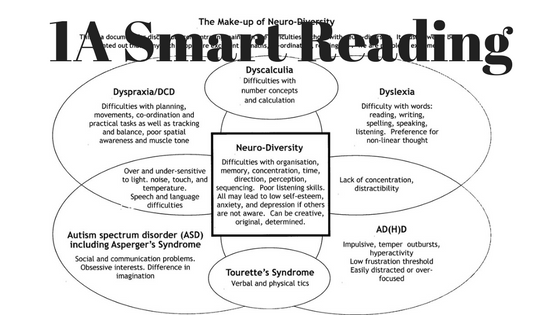
Silberman “Neurodiversity”
In groups of 2 or 3, go through the article and write one sentence about what each paragraph is about. Stick to one sentence! You should each take notes, I will be calling on people to read their sentence. There are nine paragraphs so you should have eight sentences since I did the first one.
Sociologist Judy Singer, autistic herself, coined the term neurodiversity to highlight that people with autism, dyslexia, and ADHD have atypical brain wiring and unusual skills and aptitudes.
Take five minutes and write your sentences.
Gloss It and Head It
Your task is to go through each paragraph or slide of your report, to write, one sentence, about what each one does; to “gloss it.” If the paragraph requires more than one sentence or if there are sections of the paragraph that are not covered in the sentence, this should show you that you need to focus the text, and perhaps move some of the ideas. You may even be able to use this sentence in your report.
Another thing you can do is to give the paragraphs or sections of your report headings. The heading will define the purpose of each paragraph or group of paragraphs.
This activity is meant to show you how you organized your report and to rethink how you may organize it more effectively.
Creating Structure
There are many different ways to structure a report. Decide on the final type of report you will be writing and we can begin to outline the structure. There are as many ways to organize a report and there are types of reports. Here are some examples from your book.
- Organize by date, time, or sequence
- Organize by magnitude or order of importance
- Organize by division
- Organize by classification
- Organize by position, location, or space
- Organize by definition
- Organize by comparison/contrast
- Organize by thesis statement
- Organize by genre (Wikipedia, Encyclopedia, News Report)
You do not have to develop your own structure from scratch, although you can. Look at examples of the type of report you are writing to help determine the structure for your report.
Example: Look at a Wikipedia entry similar to your topic. How is it structured? What order do they present information?


Para 1: Sociologist autistic Judy Singer, revealed a term describing different people with disability on autism and ADHD, called neurodiversity.
Para 2: Autistic people have a unique way of IQ that is not registered as normal IQ and have different set of standards.
Para 3: The new word Neurodiversity made it into the papers, Hotwired.
Para 4: When employment comes, HR people are hesitant to hire new employees with symptoms because they are afraid that they will not be able function right among other peers.
Para 5: Neurodiversity doesn’t mean that it is an end to human life, but its a different diversity.
Para 6: Neurodiversity has gained support from the internet.
Para 7:
LikeLike
What are some reasons we read?
Some of the reasons we read is to educate ourselves and learn about writers before us and their work, style, and technique, and to gain knowledge.
Paragraph 2: Autistic people are intelligent in their own way; autistic brains are easily distractable.
Paragraph 3: Neurodiversity made its first appearance in 1998 on The Atlantic.
Paragraph 4: Companies prefer to not hire autistic adults or adults with symptoms because they are worried they won’t be able to cope with the rest of the company or environment.
Paragraph 5: Neurodiversity doesn’t mean you can’t do anything, it just means you are different.
Paragraph 6: The internet helped Neurodiversity gain support.
LikeLike