
Do We Blame Ourselves?
Some may say that humans are to blame for the rapid increase of global climate change and the negative effects it has on everything around us. People are blaming the everyday activities that humans do such as driving to work and back home. Also, the industrial work that is being done by us, resulting in the tons of greenhouse gases that are being emitted into the atmosphere is another example of a negative factor. We release a ridiculous amount of carbon dioxide and methane into the air, which are both greenhouse gases. This is considered to be the main contribution to the extremely rapid climate change that is occurring. The effects of massive volumes of greenhouse gases being released into the atmosphere causes it to trap the heat from the sun. Furthermore, the ice on earth is beginning to melt at a very alarming rate causing an alertness to society. Thompson and Kuo state that “The average melting rate is twice as fast than it was four decades ago” (p. 120). To avoid increasing the speed of global warming, we need to increase the use of alternative forms of energy usage such as solar, wind, water, and nuclear energy. If the world doesn’t act now then, any method that we could think of would no longer have any efficiency.
The Earth has always been warming, it didn’t just start to warm all of a sudden due to the innovations humankind has come up with that caused it to warm more than it should be. The Earth should be at an average state of warmth, that keeps the world’s ecosystem, atmosphere, and air pollution balanced enough to sustain human life and other species of animals, to where it is comfortable. Although, that is not the case anymore. The Earth is so hot now that it’s causing dramatic effects of living to all forms of life. The air around us is becoming much thicker than it used to be, due to the abundance of greenhouse gases that are emitted by vehicles into the atmosphere. Thompson and Kuo state that “Another effect of global warming is the sea level rising at a dangerous pace, this is due to the large ice caps and glaciers melting beyond the normal average pace” (118).
The large emissions of greenhouses gases are said to be the main contribution of global warming. Greenhouse gases are gases such as carbon dioxide, methane, nitrous oxide and ozone, they absorb infrared radiation, therefore trapping heat into the atmosphere, making the Earth’s temperature rise. Not all of these gases contribute the same amount when it comes to warming the Earth, authors Zeman and Rich state that “some are more potent than others, for instance, methane has 25 times the warming efficiency than carbon dioxide and nitrous oxide has 230 times more the warming efficiency” (p. 68). Large amounts of greenhouse gases are being released into the atmosphere. Zeman and Rich state that “… while there are a number of natural sources for these compounds, the majority of these compounds come from the combustion of fossil fuels such as coal, oil, natural gas, deforestation and and various industrial processes that generate the gases as by-products” (p. 68). Just to add some perspective on the various ways greenhouses gases are emitted, all the vehicles we use everyday, such as commercial cars, airplanes, public transportation and lots of other industrial vehicles are considered to be a huge chunk of the greenhouse gases emitted into the atmosphere. Not only from the couple billion of people that are driving them everyday by burning fossil fuels, but also when they’re being mass produced in factories. The effects of greenhouse gases are responsible for the amount of heat that is being trapped into the atmosphere, which has sort of a domino effect which leads to the uncontrollably melting ice caps and glaciers, which then causes the sea levels to rise drastically. There is so much evidence that proves greenhouse gases are the main issue when it comes to global warming.
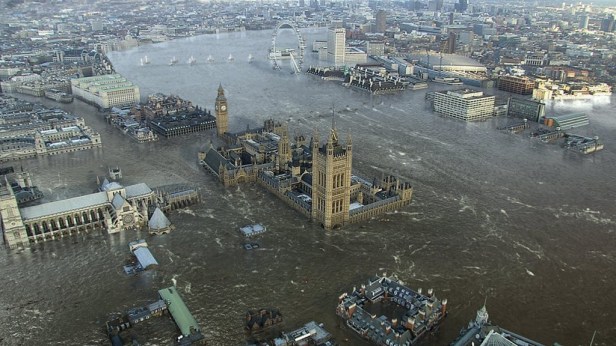
As mentioned before, the large emissions of greenhouse gases lead to the large ice caps around the world to melt at an alarming rate, glaciers are also heavily affected by greenhouse gases and melting just as fast as the ice caps. Greenland is mainly looked at for the data about the melting ice caps and the glaciers. North and South Antarctica are also used for data. Scientists use these three main locations to come up with theories about how much the sea level will rise if all the ice at these place were to melt. Thompson and Kuo state, “if the Greenland ice sheet were to completely melt it would release enough water to raise the sea level by 7 meters. West Antarctica’s melting ice would raise the sea level by over 5 meters and East Antarctica’s ice would raise it by 50 meters” (p. 118). Just imagining what kind of effect that would have on Earth is beyond terrifying. Thompson and Kuo also add, “If the Earth were to just lose 8% of it’s ice, the consequences would be horrific. Big cities such as New York, Shanghai, and other low-lying cities would be completely submerged underwater” (118). William Gail states, “ 30% of the Earth’s population live in areas that are just about 10 meters above sea level…” (198). This means that we would lose about 2.4 billion people due to flooding, if Greenland’s ice sheet and West Antarctica’s ice were to melt. Not only will losing that amount of the population be devastating it will likely cause the economy to collapse. It is imperative that we begin to act on any ideas that seem plausible towards reducing the speed at which the ice is currently melting at, due to the amount of greenhouse gases in the atmosphere.
With the replacement of fossil fuels with solar, wind, water and nuclear energy the rate of which global warming is at, can be reduced significantly because the combustion of coal, oil, and natural gases would be minimized. For example, if there were to be a car that is created to run mainly on solar energy and a battery, the emission of carbon dioxide could be greatly reduced if everyone were to drive a car that is solar powered. Another ability that the car would include is when people are out driving and the sun is out, then the car would constantly be charging the battery of the car making it a very efficient car. Of course, there will likely be some obstacles that engineers would run into, but if we keep enough funds into the idea they could focus on creating a car like this and they could make it perfect. It is without a doubt that we cannot completely abandon the use of fossil fuels but with this solution we could certainly minimize the amount that is emitted into the atmosphere. If we should choose not to act now, John Berger stated, “a report to the World Bank by the Potsdam Institute for Climate Impact Research and Analytics concluded that the world is on a path to an average temperature rise of more than 7 degrees fahrenheit by the year 2100. This puts the climate at great risk of reaching a ‘tipping point’ at which large irreversible climate changes amplify the initial human-induced warming in a positive feedback cycle to create uncontrollable planetary overheating” (32). To be able to start having an effect towards the steadily rising temperature of Earth, we need to work together to find alternative forms of energy that could minimize and hopefully replace the use of fossil fuels. The importance of new or improved innovations that use solar, wind, water or nuclear energy is at an all time high demand. If we are unable to find an impactful solution to global warming then we could soon be suffocating on the dense air around use due to the billion tons of fossil fuels that we use; drowning in our own homes due to the drastic sea level rise that should occur if all the ice on earth were to melt. At this point it should be crystal clear to everyone that we cannot afford to waste anymore time debating if global warming is mainly caused by humans, the point is, it’s an issue that we should all focus on repairing together.
Although, there is some heavy skepticism regarding if humans are even the reason why global warming is at the current rate of which it is at. David Wheeler stated, “ among those who doubt global warming is actually real, a Stanford poll last year found that their skepticism had grown even stronger” (1). People can actually disregard all the evidence that scientist have researched and still deny that global warming is not an actual issue. David Wheeler also stated that, “Those who are extremely or very certain that global warming is not happening rose from 35% in 2010 to 53% in 2011” (1). It is unclear why the amount of people that deny global warming is real increased a significant amount, although it may have to do with reports of evidence showing that the Earth’s rising temperature is normal or the lack of evidence showing that human caused carbon dioxide emissions are too low to cause the Earth to heat up. Norman Paterson stated, “ the fact that the world has undergone numerous cycles of heating and cooling has been known for a very long time, but the question as to man’s influence on climate did not become a hot debate until after the mid-twentieth century, when Revelle and Suess first drew attention to the possible effect of greenhouse gases on the earth’s temperature” (p. 41). Technically, in theory if Revelle and Suess did not bring up that point about greenhouse gases raising the Earth’s temperature people would not be blaming human-induced carbon dioxide emissions for global warming.
According to Schuldt et al, “the factors that influence whether citizens believe that global climate change is real includes political orientation, perceived and actual temperature increases on Earth, years of education and exposure to and trust in science and the media” (p116). Schuldt, et al. also mentioned that, “many Americans remain skeptical that global climate change is really happening, despite the scientific consensus that the planet is warming 33% of Americans see ‘no solid evidence’ for this issue” (115). Because of these and many other factors that weren’t listed, people can easily dismiss the attention that global warming needs to receive, no matter if it is influenced by humans or not.
Instead of continuing to blame ourselves for global climate change, we need to work on solutions instead of only the problem. If we continue to emit the large amounts of greenhouse gases into the atmosphere as we do at the moment, it’ll be too late to even attempt to save ourselves. The air around us will be to thick to even breathe without any filters around our faces. We would no longer have any land to live on, because every piece of the Earth will be submerged under water. Countless lives will be lost due to all these effects of global warming, only if we choose to ignore it, just as a large majority of the Earth is doing right now. Together we could have an impact on the rising temperatures on Earth, all that would need to be done is to come up with new innovations that would replace the dependency of fossil fuels with alternative energy such as solar, wind, water and nuclear energy. For example, the previously mentioned solution of creating a car that runs solely on solar energy, therefore minimizing the emission of greenhouse gases. The responsibility of caring for the Earth lies in our hands and we need to act now if we want to continue living on it for a long time.
Works Cited
Berger, John J. “Hot Under the Collar Over Global Warming.” USA Today Magazine, vol. 142, issue 2818, July 2013, p. 32-33. http://web.a.ebscohost.com.chaffey.idm.oclc.org/ehost/detail/detail?vid=1&sid=c97ab026-d7d3-45d1-be98-19f8ed8bcb90%40sessionmgr4007&hid=4209&bdata=JnNpdGU9ZWhvc3QtbGl2ZQ%3d%3d#AN=89130994&db=a9h, Accessed on May 1, 2017.
Gail, William B. “Achieving Climate Sustainability.” Bulletin of the American Meteorological Society, Feb. 1 2010, p. 197. http://web.a.ebscohost.com.chaffey.idm.oclc.org/ehost/pdfviewer/pdfviewer?sid=33607b0d-7e8d-4a9f-bcc6-4af2ef5f0c1b%40sessionmgr4010&vid=8&hid=4209, Accessed on May 1, 2017.
Paterson, Norman. “Global Warming: A Critique of the Anthropogenic Model and its Consequences.” Geoscience Canada, Vol. 38, issue 38, Mar. 2011, p. 41-48. http://web.b.ebscohost.com.chaffey.idm.oclc.org/ehost/detail/detail?vid=10&sid=8030d90f-982e-4faa-89dd-60b1ef24e933%40sessionmgr120&hid=128&bdata=JnNpdGU9ZWhvc3QtbGl2ZQ%3d%3d#db=a9h&AN=62168414, Accessed on May 1, 2017.
Schuldt, Jonathon. “‘Global Warming’ or ‘Climate Change’ Whether the Planet is Warming Depends on Question Wording.” Public Opinion Quarterly, vol. 75, March 2011, p. 115-124. http://web.b.ebscohost.com.chaffey.idm.oclc.org/ehost/detail/detail?vid=9&sid=ecc11555-8ccf-4e26-8971-7ce4ab83c9b7%40sessionmgr104&hid=128&bdata=JnNpdGU9ZWhvc3QtbGl2ZQ%3d%3d#AN=59233878&db=a9h. Accessed on May 7, 2017.
Thompson, Lonnie and Kuo Gioietta. “Climate Change the Evidence and Our Options.” World Future Review, June 2012, p. 114-122. http://web.a.ebscohost.com.chaffey.idm.oclc.org/ehost/pdfviewer/pdfviewer?sid=086cbc4a-3ae7-453b-af4f-a10296cbf731%40sessionmgr4010&vid=5&hid=4209. Accessed on May 1, 2017.
Wheeler, David. “Inside the Clash Over Climate Change.” Chronicle of Higher Education, vol. 58, May 2012, p. A1-A14. http://web.b.ebscohost.com.chaffey.idm.oclc.org/ehost/detail/detail?vid=4&sid=e9cdeeb3-f76c-4928-aa3a-747421d688c4%40sessionmgr104&hid=128&bdata=JnNpdGU9ZWhvc3QtbGl2ZQ%3d%3d#AN=75194741&db=a9h. Accessed on May 1, 2017.
Zeman, Catherine and Rich Michaela. “Composting In a Hot World- The Cool Facts.” BioCycle, Dec. 2001, p. 68-76. http://web.b.ebscohost.com.chaffey.idm.oclc.org/ehost/pdfviewer/pdfviewer?sid=2b2865ee-4f06-4a1f-ab69-869a9da95fab%40sessionmgr101&vid=6&hid=128. Accessed on May 1, 2017.


1. My essay does have a clear thesis, and purpose addressing the topic of issue, with an arguable solution.
2. My essay provides a very clear description of the issue being addressed, it is perhaps slightly too descriptive.
3. The solution is very clear, along with provided evidence addressing the benefits of the solution.
LikeLike