
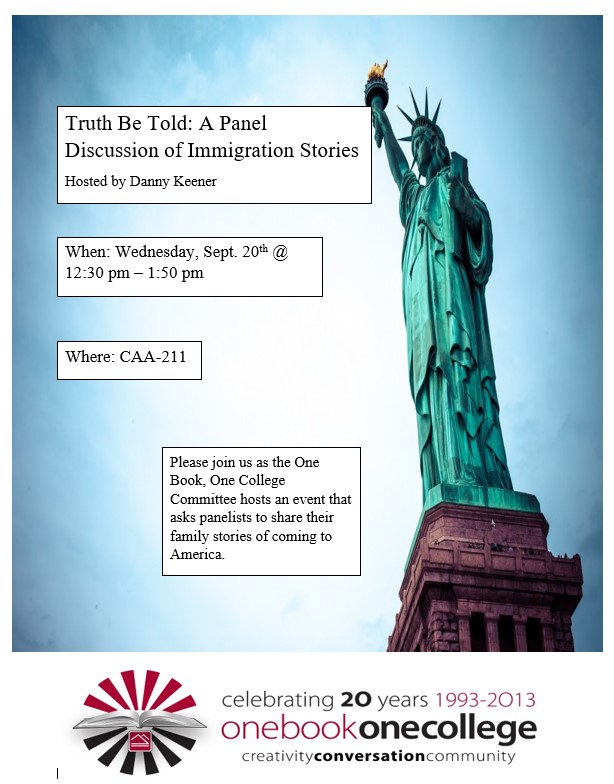
For extra credit, you can attend the Truth Be Told panel on Wednesday, September 20th at 12:30 to 1:50 pm. See image for full details. You have to have proof you went, a handout or a picture of you at the event and write up a short description of what you learned and how it connects to the book we are reading.


What did I learn from the panel and how did the panelists’ stories connect to the book we are reading?
I can relate to the panelists lives on a different experience. I’d be approached by people who speak Spanish and they would begin speaking to me in Spanish, but all I would do is tell them “Um, I’m sorry. I don’t speak Spanish,” or “I don’t understand what you’re saying.” I’m confident that the panelists have felt the same frustrations as I have when trying to have a conversation with someone who speaks the same language. Leaving their homes was very difficult for all of them, especially when they were so young and had no idea what would happen next. The five panelists shared their stories and what it was like to cross the border. Their stories shared several similarities, such as going to Tijuana to get to San Diego, which was what the majority of them said they did. They all struggled to find out what they want. Several of the panelists explained that they didn’t see any point in going to school if they couldn’t speak the language. They would get teased and bullied because of their accents. But that one negative thought about staying in school made them seek betterment for themselves. They found ways to gain support, such as DACA and the Dreamers Club. When they were in high school towards the end of their last year, they didn’t know how to fill out applications, they didn’t know what financial aid would do for them, and some didn’t even have a social security number. I asked them a question that I tried to prevent myself from asking, but I couldn’t leave it unasked. I asked the panelists “Are you all happy where you are at? Do you think you’d be happier if you stayed?” One thought it would be an act of selfishness, which I never thought of it in that certain aspect. The parents of the panelists ultimately risked their lives for their children to have a better life, but if they decided to go back to where they were from, it would be selfish to do so. That really opened my eyes. The rest of them stated that Mexico will always be home no matter what, but this is their home now and that they couldn’t be happier. From this panel, I learned that illegal immigrants have worked so hard in order to make their way to success. They started from the bottom and now they are living the lives they never thought they would have. Their stories connect greatly towards The Book of Unknown Americans because it shows the struggle of coming to a new world, not knowing where everything is, not knowing how to speak the language, seeking others who are like them that speak the same language and the fear that they’ll get deported. They had to go through so much just to feel accepted. But all of those struggles led them to achieve anything they wanted. It made them better themselves as human beings.
LikeLike
Attending the One Book One College Truth be told Panel discussion was one of the best things I’ve experienced so far on this campus. The entire session was a big eye opener to not just immigrants that risk their lives coming to America to be a part of the American dream, but also citizens that think that these people are just ‘Illegal’ intruders that need to be deported. Most of these stories were very heartbreaking and emotional, no one on earth should have to go through the struggles these immigrants endured, just to have a normal happy life. These people have all fled their country that they love so much because of poverty and domestic abuse. One story, in particular, that had me in tears was that one panelist, who alongside her siblings got split up and sent to the U.S with completely different sets of strangers and given fake identities that they couldn’t even remember. The lady spoke with tears in her eyes as she explained how this stranger threatened to leave her by the side of the road in the middle of nowhere if she couldn’t remember the fake name given to her. This is no way for any eight-year-old child to remember their journey to a better life or someplace that supposedly had hope. She watched these strangers brought in her siblings a week after; then another set some days after and then the parents came too. This was screaming sacrifice and faith in its loudest form. So much could have gone wrong the kids could have been kidnapped, raped God forbid, even killed. By faith, hope, and sacrifice these parents took the risk of doing all this so that they could have a better life.
What is even more fucked up is the fact that after all these people go through hell and high waters to get here. From crawling through ditches, running across desert areas for days with only tortillas and water and sometimes no food at all, being pregnant in the mix etc., yet the country that they sacrificed to live a better life in makes it tough for them. It’s sad to say America has a lot of Garrets that prey on these people, make them feel low and unwanted. They get the shittiest jobs with the longest hours, get paid chum change but they’re still appreciative and work their asses off to make two ends meet. They’re not guaranteed a career or a complete education all because they don’t have that one piece of paper that screams “citizenship”. Sometimes these immigrants do even more in this country than a lot of the spoilt ass Garrets that think their shit could make a patty. It’s sad all the way around to know that these people live in fear every day and constantly walk on eggshells thinking they could be scooped up like a pile of trash and get deported any second.
This is not how the world should be. Everyone deserves to be happy and have the right to a bright future. America is seen as a heaven for millions of people but why is there so much dirt and grime in heavens crevices? The color of our skins should not determine who gets to be happy and who gets swept under the rug. I wished all Americans including the president had a chance to listen to these people’s stories and pull their heads out from behind and realize we’re all humans. It’s sad to say that there are so many Arturo’s, Almas, Malibels, Celias, Rafaels, Mayors, and jerks like Garret and his sorry ass dad living amongst us. Thanks to programs such as DACA and the dreamers club on campus that allow these unknown Americans to have a voice, and hope.
LikeLike
The One book, One College panel was a very enriching experience for me. Not only did the panel change my opinion on illegal immigrants, but it also gave me some more insight on the lives of immigrant, aiding me in my understanding of The Book of Unknown Americans. Going into the panel, I thought we were going to talk specifically about the book, but It was only mentioned once, nearing the end of the panel. But what I experienced during that panel was much more enriching. There were five latino immigrants who told their stories. To me, this was almost like a needed addition to The Book of Unknown Americans. In the book, we get multiple side stories from the side characters.about their struggles and their lives in America. The stories that I heard from the panelists were similar to the ones that I read in the book, but at the same time, they were individual and different. While the book gives stories of people who are already settled into the US, the stories I heard were from people my age, filling in a gap that the book left open. Seeing and hearing these actual immigrants, instead of reading about them, showed me that immigrants, illegal or not, are still human. This panel was an incredibly enriching experience.
LikeLike
When I walked into the room, the speakers had already begun telling their stories. There was a sense of in the air that was very familiar to me. It was very serious. I sat in the back and I examined the speakers of the panel. They were all young college kids. 1 or 2 of them looked to be around my age, but otherwise, they were just kids. Their stories were much like that of the characters in The Book of Unknown Americans. There seemed to be a central theme to all of their stories. They crossed the border illegally, and became undocumented workers and students, they knew no English, but they had a great desire to learn as much as they possibly could. They’re passionate about so many things, the biggest thing being a better life for themselves and their families. Once they got here and began settling in, they all seemed to find a club or group of similar people that gave them a sense that they weren’t alone, and they weren’t the only ones going through the tough situations they were going through.
One of the female speakers said something that stuck with me. She didn’t speak English at the time that this happened, but she was working in a warehouse, and she was talking to some of the other workers, and she asked how long they had been there, just making conversation. They also were undocumented citizens. The answers began ringing in, “10 years” one said. “15 years” said another. She began to think about that and ponder her future. She had the wherewithal to recognize a dead end when she saw one. So, instead of stay somewhere she saw no future in, she decided to leave the security of a paycheck and sought after something she saw as more valuable… An education. Generationally, it seems, the undocumented youth can see the benefits of an education, while their elders don’t seem understand and believe they just need to keep their heads down, work the job they have as long as they can and collect a paycheck with no questions asked. The youth of today are trying to break that cycle.
LikeLike