
Can the children of America be considered healthy when a great percentage of its adult population is considered obese? This report will look at the current state of the school lunch program that are offered and monitored by the government. Since school lunches are a big part of many children’s lives up until they are the age of 18 it is vitial to see just how the program measure up. The following report will investigate the realities of the food that is offered at schools and how their nutritional value measures up. School lunch programs were first introduced to help combat the poor nutrition in children, it has now developed into a massive federal funded program where, private corporations decide what is offered, children’s unhealthy appetites are the deciding factor on what should be served, and where high obesity rates are the outcome to this mismanaged health crisis.

According to Hiemstra, school lunches were first introduced to the American school system during the World War II when they found that many young men had to be turned away from their call of duty due to lack of proper nutrition that would make them capable soldiers. The government came to the realization that in order to ensure they could always count on future generations, they would need to start implementing a federal lunch program into schools to ensure that the next generation would grow up healthy. Having a school lunch program in place was especially crucial in locations throughout the country where children came from underprivileged neighborhoods. The U.S. government then introduced the National School Lunch Act in 1956 which promoted the National School Lunch Program or NSLP in America to look after the well being of children as well as insuring proper nutritious foods were being consumed. Schools were then entrusted to provide lunches for purchase for those who could afford it and offer free lunches to those who could not. The program was also expanded to offer breakfast meals before school started in 1975.

The way the NSLP is organized is by monitored federal spending throughout schools in America. Yeoman communicates all this by indicating that the federal government offers up to $6 billion a year to schools so they could offer low cost meals to students. It is able to do this because the program overall is, “designed to subsidize agribusiness, shoring up demand for beef and milk even as the public’s taste for these foods declines.” With this, the program it also double dips by allocating up to $800 million worth of farm products each year. Not only does this give farmers a guarantee of income each harvest but it also gives schools the ability to allocate food for free for their students. The main products that were subsidized by the government, beef and dairy products, are actually extremely high in saturated fats. So, since it made up a big part of children’s diets in schools it hindered the nutritional value that children received. By buying surplus of food like this, the government was able to offer schools this food to freeze to use later. Soon this became the model for handling the school lunch program which meant more money was being allocated toward beef and dairy products. This meant of course that the budget for fresh fruit and vegetables has been dwindled. According to David Ludwig “School districts are under intense budgetary pressure, and oftentimes nutrition is at the bottom of the priority list. ” (Yeoman). The article goes on to clarify that schools are the last ones to be taken into consideration during this exchange, they are simply the ones who must do what they can with the food being given to them for free.

The next biggest influence is what type of food is offered to kids in school. It has been pointed out that private commercial food companies are the ones with that deciding power. They have been credited to have lobbied their way into school cafeterias, Haskins’ article lists big corporate companies like Tyson and Archer Daniels Midland as one of the many advocates behind making their products readily available in schools. These private companies not only helped to answer what could be provided but it also set the schools up to turn a profit by selling items for purchase to kids. Due to the financial hardship of budget limits schools felt they had to turn to contracts to help offset the cost with their limited funds, when this happens “the companies have the purchasing power — not the schools.” (Oberst). At this rate, unhealthier options have now made their way into school lunches with the addition of the number of vending machines on campus. “Vending machine trends are contrary to healthy eating and undermine any nutrition education that children may learn in school or at home” (Unhealthy Foods). The Unhealthy Foods article also infers that students’ options for healthy choice’s such as a fruit or vegetable, only made up for 15% of the overall options they could choose from. The unhealthy options won the dollar vote and so, there is no push to make changes.
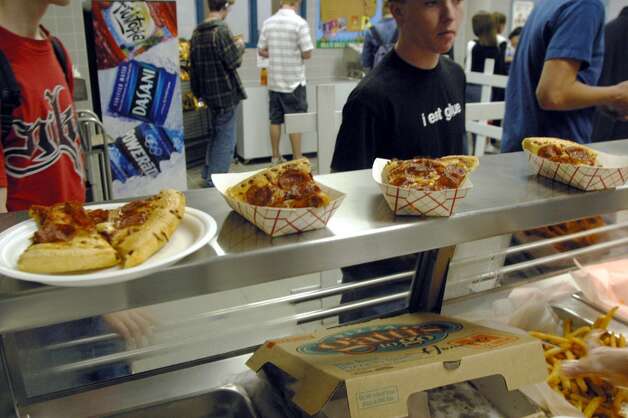

It is not just the options that are available for students that have caused a shift in the health of young children, school officials have attributed the unhealthy food options offered due to the kids appetite’s. The reason behind this, Yeoman explains is, “they have to serve fatty meals to satisfy the tastes of children raised on McDonald’s and Domino’s.” Yeomans article goes on to say that the rise of fast food diets in children all over America meant that kids are used to high processed fats found in various fast foods, which means that schools were faced with the problem of children not feeling full during lunch. Schools have reiterated that “adding fat is sometimes the only way to get kids to eat green vegetables.“ (Yeoman). The current struggle that schools face is trying to determine the right balance of what to offer. Schools not only must provide kids with enough to make them full, but they also have to put the right food on the plate so that kids will eat all of it. When the food is thrown out and not eaten, it defeats the purpose of spending the budget on it, which is why the options do not change to healthier options.

Currently America is reporting record high levels in obesity among children as of yet. The realties of this epidemic are observed to show that, “obesity rates have doubled in children and tripled in adolescents since 1980, spurring an epidemic of type II diabetes, once considered an adult-onset condition. “(Yeoman) That children of America are much heavier than ever before in our history and a big part of that reason is the food they eat. The Yeoman article also reports that due to current state of health in many children, they are at risk and on track to develop heart disease, arthritis, and certain cancers due to the obesity crisis. According to Haskins, the children who are most at risks to develop obesity from a young age are children who come from low income households. Marion Nestle echoes this as well, “The higher prevalence of obesity among people of lower income and education can be explained by greater consumption of low-cost, high-calorie foods.” (Carroll, and Fernstrom, PhD). Fast food is cheaper to buy and therefore it becomes the main source of that child’s nutrition. The lack of physical activity in kids’ life both at school and at home is also a threat to obesity epidemic.

The current unhealthy options offered during school hours are greatly affecting the overall health of the nations children. The ongoing epidemic of childhood obesity is what is at risk here. Many children rely on the school lunch programs to offer them food, that means for at least a total of 36 weeks of a child’s life in a given year, the food options are being made for them. Having a child’s preference dictate what is served has shown to be detrimental to their future health. The major companies who offer their products have gotten by off the overall bad quality of the food simply because of cheaper cost. Since they are easily storable and have a high shelf life they are favored to keep around, but the highly over processed foods that offer little to no nutritional value come with a grave price tag. With limited budgets, the option to purchase fresh fruit and vegetables is stacked against schools and are not cost effective to fulfill the NSLP budget. Thus children nutritional needs are not meant, but instead put their future health at risk, the NSLP has not fixed what it once set out to do. Instead we see a future where children are already on track to develop life altering health conditions.
Work Cited
Carroll, Linda, and Madelyn Fernstrom, PhD. “Cheap Food Blamed For America’s Obesity Crisis”. NBC News, 2014, https://www.nbcnews.com/better/diet-fitness/cheap-food-blamed-america-s-obesity-crisis-n112141. Accessed 16 Sept 2019.
Haskins, Ron. “The school lunch lobby: a charmed federal food program that no longer just feeds the hungry.” Education Next, vol. 5, no. 3, 2005, p. 10+. Gale In Context: Opposing Viewpoints, https://link-gale-com.chaffey.idm.oclc.org/apps/doc/A136199653/OVIC?u=ranc95197&sid=OVIC&xid=94871bee. Accessed 17 Sept. 2019.
Hiemstra, Stephen J. “School Food Programs.” Encyclopedia of Education, edited by James W. Guthrie, 2nd ed., vol. 6, Macmillan Reference USA, 2002, pp. 2131-2136. Gale In Context: Opposing Viewpoints, https://link-gale-com.chaffey.idm.oclc.org/apps/doc/CX3403200541/OVIC?u=ranc95197&sid=OVIC&xid=2d5cfe51. Accessed 17 Sept. 2019.
Oberst, Lindsay. “Why School Lunches In America Are Unhealthy And 10 Ways You Can Take Action To Improve Them”. Food Revolution Network, 2018, https://foodrevolution.org/blog/school-lunch-in-america/. Accessed 16 Sept 2019.
“Unhealthy Foods Bulk of School Vending Machine Choices.” Nation’s Health, vol. 34, no. 5, June 2004, p. 7. EBSCOhost, search.ebscohost.com/login.aspx?direct=true&db=a9h&AN=13356802&site=ehost-live.
Yeoman, Barry. “School Lunches Cause Childhood Obesity.” Food, edited by Laura K. Egendorf, Greenhaven Press, 2006. Opposing Viewpoints. Gale In Context: Opposing Viewpoints, https://link-gale-com.chaffey.idm.oclc.org/apps/doc/EJ3010432224/OVIC?u=ranc95197&sid=OVIC&xid=74f6f4df. Accessed 17 Sept. 2019. Originally published as “Unhappy Meals: School Lunches Are Loaded With Fat—And the Beef and Dairy Industries Are Making Sure It Stays That Way,” Mother Jones, 2003.


