
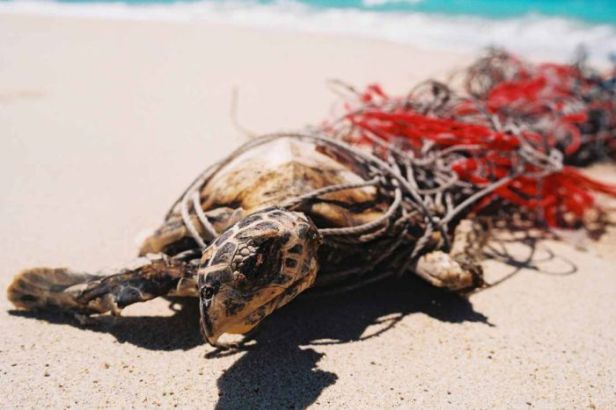
Imagine a world where the ocean had no color, no animals, no life. It was dark and grimy like oil had taken the place where there was once clear water, and instead of sea creatures swimming beneath you it was just plastic bottles and trash. The ocean houses over 1 million exotic species from tiny crabs to whales that weigh more than a car. “Many of these riches are hidden in the depth of the oceans which cover 71 percent of the earth’s surface and contains an estimated 90 percent of all lifeforms” (Binney). With that being said many environmentalist and scientists are trying to help change the world as we know it to help decrease the amount of pollution that it’s making its way into the ocean. Pollution in our waterways have gotten dangerously abundant to the point that many sea animals are going extinct such as the Caribbean Monk Seal, Sea Mink, and the Tecopa Pupfish. Trash and different chemicals are being washed into the waterways and are harming sea life. Random pieces of trash are being consumed or wrapped around sea creatures leading to their untimely death. When waste gets wrapped around sea life in can make it hard for them to move, eat, or breath. Pollution is causing sea life to go extinct along with their environments that are slowly diminishing.
Every day the human race is increasing at an alarming rate. With more humans, more substances are needed to maintain the everyday life style we have become accustomed to, “the study found that contamination is generally associated with the degree of urbanization such as in waters around New York city, Los Angeles, and Boston” (Merline). Billions of cars are being driven everyday which pollutes the air and factories are letting out fumes like there is no tomorrow. Even if one does not live in a highly-urbanized city that does not rid them of contributing to the pollution epidemic. In non-urbanized cities or towns many people have to fend for themselves by hunting for food to gathering their own supplies, “Kerald’s 29 million people depending heavily on fish as a food source” (Russell). Fishing one of the top pollution inducing activities. Gradually overtime boats went from flooring boards of wood to plastic like materials with engines that exhale fumes and leaves oil in the oceans, “blue waters initial campaign is an effort to ban two stroke outboard motors that are dumping the equivalent of 15 Exxon Valdez spells a year in the US waters” (Russell). These boats aren’t just killing wild life but it’s also contaminating the oceans creatures that humans consume, “One Fisher complains that fish caught in this part of the Arabian Sea have a slight feel like taste suggesting the presence of Carcinogenic levels of Hydro carbon-based chemicals” (Russell). Eventually the hope is to help cut down the amount of boats that contain motors that are heavily polluting the ocean by replacing them with more environmentally friendly boats in the hopes to help reduce pollution by fishing, and the use of motorized ocean vehicles. A study was conducted that showed fishermen actually preferred the environmentally friendly boats more than the boats they currently owned.
Whether one realizes or not living life on a normal basis is a huge contributor to the ocean pollution. Trash is produce to by almost everything we consume; some trash may be biodegradable but majority is not. Some examples a banana pile is biodegradable where as a bag of chips is not. It gets ship to a landfill where it sits for year and years to never disappear. Plastic bags one of the worst contributors to the pollution epidemic. Convenient stores are mainly to blame for the numerous amounts of plastic bags being cycle throughout the world. The government recently passed a law stating every plastic bag is a charge of $.10 if someone needs to purchase one. This has cut down the number of plastic bags being purchase because many people are purchasing cotton or canvas reusable bags for their groceries, “each year Americans throw out more than 100 Billion plastic shopping bags, which ended up polluting our oceans and killing millions of birds and fish and more than 100,000 sea turtles, according to the Sierra Club” (D.G). The government passed that law to hopefully lower the number of plastic bags that end up in our landfills and oceans. Plastic shopping bags resemble closely to a jelly fish, jelly fish being sea turtle’s favorite food. Sea turtles are mistaking these plastic bags for jelly fish and choking on them, “the leather back, which can grow to 1,200 lbs. and dive to a depth of 2,000 feet, is facing imminent extinction” (Binney). Along with sea turtles many animals mistake plastic pieces for fish or other food. When the animal consumes it, their bodies cannot digest it making the animal think it is full but in reality, it is not. The animal soon stops eating causing it to die due to starvation. Not only plastic bags cause damage alongside are plastic containers or wrappers that line our food products. To help lower the amount of plastic waste being used if one uses Tupperware instead of zip blocks or and stop using plastic bags to throw away things, lower the quantity of food you consume that is packaged in non-biodegradable materials. By doing so less non-biodegradable items will be put into our landfill eventually making its way into the ocean.
Not only is pollution killing wildlife it is also damaging and killing the beautiful environment that they live in, “more than a third of this damage is the direct results of human activity, but the greatest threat to coral reefs today is global warming” (Binney). Trash is beginning to build up at the bottom of the ocean even in the deepest parts, “one Canadian deep-sea explorer, while diving in the Arctic Ocean far away from any human settlement, found a soda can 40 feet below the Ice, nestled in a kelp plant in those temperatures he says ‘it is likely to outlast the pyramids’” (Current Legal Literature). This law prohibits the dumping of trash into the ocean if they do not have a permit. The oil that is being spilled by boats are killing the coral reefs and damaging the homes of many sea creatures leaving them with n protection from another creature which can lead to extinction. When cans and trash gets thrown into the ocean the sea life mistake it as food or shelter leaving defenseless sea creates trapped. Small fish will swim in the openings of cans not allowing them to get out without getting injured. Sea otters of birds will get tangled in ocean fishing nets and be left there to die. Another way we can help the ocean is by using less water on land. Every drop of water we use ends up in the oceans. The water we use is dirty and has chemicals and other substances in it when it returns to the ocean.
In order to help the environment Saltwater Brewery in Florida has created an edible and environmentally friendly 6 pack beer packaging, ” the edible and biodegradable 6-pack packaging is made from the byproduct of the brewing process, like wheat and barley” (Norris). Many know that people won’t stop littering so why not work with the problem. If we can’t stop people from littering why not make what there littering safer for the environment. To help the oil spills occurring in the ocean Argonne National Laboratory scientist have created a sponge that absorbs oil, “the results is Oleo Sponge, a block of foam that easily absorbs oil from the water. The material, which looks a bit like an outdoor seat cushion can be rung out to be reused” (Lerner). The Oleo Sponge is sturdy and can be changed to absorb even more substances than just oil. With these sponges being invented, ” Oleo Sponge could potentially also be used routinely to clean harbors and ports, where diesel and oil tend to accumulate from ship traffic” (Lerner). Another experiment that is being implemented is tracking pollution in oceans. This is an advanced twist on the traditional methods, “recent methods of tracking ocean contaminants involved computer models estimating the likelihood a pollutant would travel a certain path” (Mechanical Engineering). Although this method can track pollution in the ocean it is not advanced enough to tell us why things went to one location and not to another. By using this method, we can focus on the areas that pollution travels to frequently and help reduce the amount that ends out there. Hopefully furthering our knowledge on why trash ends up at that stop.
Another solution to the pollution epidemic is to have convenient store all around stop carrying any form of plastic bags at the checkout stands. Although the government has put a price on each plastic bag the bags that are given now are thicker and made of more materials. Yes, the price on plastic bags have made many people either reuse the plastic bags or by canvas reusable ones how many people are actually re using the plastic bags and not just throwing them away? They are only 10 cents to purchase another one. Now that the new bags are thicker if they do end up in a land fill they are going to take longer to degrade. Second the government should give recycling a bigger incentive. A little more than 5 cents a can so more people will begin to recycle. Thus, will lead to more items that are able to be recycled to be used over and over again instead of making a new one every time using more materials that will damage our environment, “2 million plastic beverage bottles are used in the US every 5 minutes” (Save Our Shores).
Ocean pollution and increasing epidemic that is causing death of sea animals loss of ocean environment and contaminating sea creatures that are being consumed. Cutting down on the use of plastic bags can save many sea turtle from mistaking them as jelly fish. By changing the way boats are made that can help lower the amount of oil spilled into the waterways saving innocent sea creatures from getting stuck in oil spots and save the coral reefs. By recycling and making sure trash ends up in a trash bin and not the ground. Not only are you keeping your environment clean but you’re also keeping the environment for sea life clean and safe. The ocean is a magical place and maintaining this environment is key to keeping it alive for years to come, ” what we need is a new ocean ethic to forestall us from doing to the seas what we’ve already done to large tracts of land “(Leach). Granted that the ocean is very large many don’t believe that be them throwing one soda can or one plastic bag on the floor that it won’t cause damage. According to google there is 7,515,284,153 people currently living on earth. If everyone carried that same mindset pollution would be even more of an increasing issue. In the article ‘ OH SAY, CAN YOU SEE…’WHAT WE’VE DONE TO THE SEA? Binney states, “… that it is high time for us ‘ humans to stop abusing the once abundant, but fast dissipating riches which a bountiful nature has provided for our sustenance”.
Works Cited
Binney, Gard E. “‘Oh Say, Can You See…’ What We’ve Done to the Sea?.” Ecologist, vol. 31, no. 8, Oct. 2001, p. 61. EBSCOhost, chaffey.idm.oclc.org/login?url=http://search.ebscohost.com/login.aspx?direct=true&db=a9h&AN=5260236&site=ehost-live.
D., G. “Bag the Plastic.” Natural Health, vol. 37, no. 5, May 2007, p. 22. EBSCOhost, chaffey.idm.oclc.org/login?url=http://search.ebscohost.com/login.aspx?direct=true&db=a9h&AN=24632618&site=ehost-live.
GIGES, NANCY S. “Tracking Ocean Pollution.” Mechanical Engineering, vol. 136, no. 4, Apr. 2014, pp. 12-15. EBSCOhost, chaffey.idm.oclc.org/login?url=http://search.ebscohost.com/login.aspx?direct=true&db=a9h&AN=95059930&site=ehost-live.
Keeffe, Arthur John. “Protecting the Oceans East and West.” American Bar Association Journal, vol. 64, no. 9, Sept. 1978, p. 1448. EBSCOhost, chaffey.idm.oclc.org/login?url=http://search.ebscohost.com/login.aspx?direct=true&db=a9h&AN=4800100&site=ehost-live.
Leach, Susan Llewelyn. “A New Ocean Ethic.” Christian Science Monitor, vol. 90, no. 230, 22 Oct. 1998, p. B1. EBSCOhost, chaffey.idm.oclc.org/login?url=http://search.ebscohost.com/login.aspx?direct=true&db=a9h&AN=1194661&site=ehost-live.
Lerner, Louise. Argonne invents reusable sponge that soaks up oil, could revolutionize spill clean up. 1. May.2017.
Long, Russell. “Two-Stroke Pollution.” Earth Island Journal, vol. 11, no. 3, Summer96, p. 10. EBSCOhost, chaffey.idm.oclc.org/login?url=http://search.ebscohost.com/login.aspx?direct=true&db=a9h&AN=9607312707&site=ehost-live.
Merline, J.W. “Ocean Pollution.” Consumers’ Research Magazine, vol. 74, no. 5, May 1991, p. 38. EBSCOhost, chaffey.idm.oclc.org/login?url=http://search.ebscohost.com/login.aspx?direct=true&db=a9h&AN=9105200822&site=ehost-live.
Norris, Bridgette. Flordia brewery creates biodegradable and edible 6- pack packaging.May20.2016,Orlandoweekly.com.Accessed 1. May 2017

