Negrete, Christopher
Mr. Ramos
English 1-A
9/31/19
Caring for Sea Life
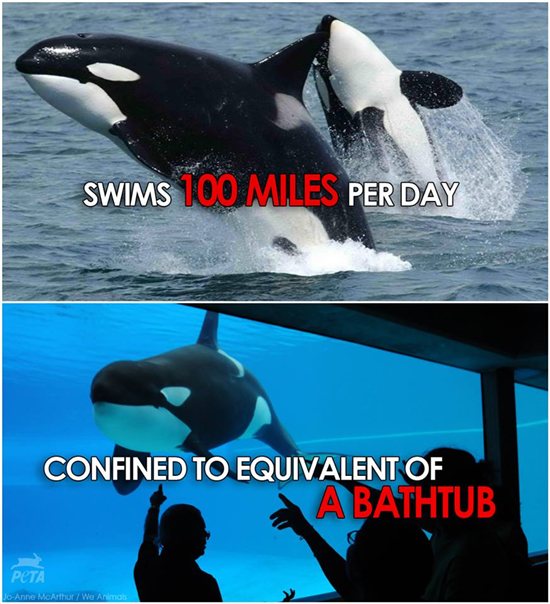
Anatole France once said, “until one has loved an animal, a part of one’s soul remains unawakened”. For the past 60 years Sea World has been known for their amazing shows where Dolphins and Orcas will perform tricks for the entertainment of many people across the world. Sea World had first opened around 1964 and has grown intensively to the point where they are still attracting new customers despite the media attention they have gotten about their treatment towards animals. Sea World may have improved their equipment and space for their animals, but they are still mistreating these animals. They might not be intentionally trying to mistreat these animals; however, these animals are not happy and extremely stressed due to the routine that they are put through. Many of these animals travel across large distances every day in the wild but are now confined to such small spaces. A counter argument to these statements is that Sea World has saved the lives of these animals that were close to dying in the wild and are now able to conduct better research about these animals.
Sea World started out with small shows with a few dolphins doing some tricks to entertain a small crowd of people, but as the years have passed these tricks have gathered the attention of more people and the number of animals used in each of these shows has increased as well. Usually animals that participate in these shows are given treats and affection for the tricks that they do. However, when the lights are down these trainers must force feed them vitamins, antibiotics, and antacids. This is obviously for the good of the animals, but from the animals’ perspective this can make them very stressed and anxious when this is done on a daily basis. Aside from the stunts and tricks that are performed with the animals, there are certain animals that are forced to mate with each other in order to conduct testing in the birth process. With this relationship between the trainers and animals there can be times when these animals can be very aggressive towards the trainers. An example of this actually happening was written by an ex-SeaWorld employee, David Kirby. The title of the book is, “Deaths at SeaWorld”, it gives a detailed account of the life and treatment of these animals and it describes how injuries and events surrounding the animals are poorly recorded. For example, many of the injuries involving orcas mounting their trainers are not reported, but when the death of a trainer happened during a live performance there was an investigation that resulted in a fine of $75,000 in 2010. These animals were once free and are now being forced to do tricks for the entertainment of people, it’s no surprise that there would be some injuries towards the people forcing them. Its not entirely the trainer’s faults though, due to such poor recordings of these events, they have no idea of the risk that comes with handling these animals.
The size of Sea World is 8,712,000sq ft, which is .3125 square miles. An orca in the wild swims about 75 miles a day, so when comparing these two distances (not including that the size of their enclosure is much smaller than the park itself) these orcas are not getting the necessary exercise and space to move around in. The pools that many of these animals are kept in appear to be very large to us, but to these animals they must appear to be bathtubs. Many of these animals have to share such a small space with each other making these enclosures even smaller for them. Within the couple of years that have passed, the enclosures for these animals have increased, but not significantly enough to where the space is close to what they had in the wild. This relates to mistreatment towards these animals because SeaWorld is trying to make these animals lives more comfortably, but by having them living in such a small space limits the freedom they are given.
SeaWorld has kept a close eye on these animals, monitoring their health and behavior. This has led to advancement in the understanding of these animals, especially the orcas. I have actually been to a show for the orcas and they’ve shown the research and data that they’ve collected over the years from watching these animals closely. When questioned why they can’t just monitor the animals from the wild, they said that by befriending the animals in the enclosure and seeing them on a daily basis they are able to get more precise data. They have a clip of an orca allowing a trainer to collect breast milk to collect data from it. They have also stated that they no longer remove the babies from the parents when they are born but do take them when they have to check on their health. Although they have been able to get data from these animals by having them enclosed at these places, there isn’t a need for keeping them in such a small space and to have them performing tasks that they do no want to do. Recently it has been announced that SeaWorld will no longer have orcas, and this will be the last generation of orcas that will be at their parks. They stated, “Our goal is to help our guests, and the world, explore the wonders around them, and then inspire them to take action to protect wild animals and wild places. SeaWorld’s killer whales are vital to that mission” (SeaWorld). This may be the last generation of orcas, but it doesn’t mean that all the other animals have the same fate.
SeaWorld has changed ever since it first opened in 1964 and
grew to be the giant aquarium that we know it to be now. Despite SeaWorld’s efforts
to improve the treatment of their animals they haven’t eliminated the fact that
these animals are still being mistreated in the sense that they don’t have
their freedom. These animals are forced to perform tricks for the entertainment
of humans, while we have stated that these animals are very intelligent. We
have also taken them from the vast and open environment and placed them into a
small enclosure taking away their freedom. Some say that this will help these
animals in the future and hopefully better our understanding of these animals’
habits and health.
Sources
“Conservation Efforts.” Committed to Conservation – Park to Planet | SeaWorld Orlando, https://seaworld.com/orlando/commitment/conservation/.
“Center for Whale Research – Questions.” Orcas // Killer Whales | United States | Center For Whale Research, https://www.whaleresearch.com/orca-questions.
“Longevity & Causes of Death.” SeaWorld Parks & Entertainment, https://seaworld.org/animals/all-about/killer-whale/longevity/.
“Deaths at SeaWorld: Animals Are Dying to Entertain In This S.” Psychology Today, Sussex Publishers, https://www.psychologytoday.com/us/blog/animal-emotions/201207/deaths-seaworld-animals-are-dying-entertain-in-s.
Schelling, Ameena. “Ex-SeaWorld Employee Gives Chilling New Details About Orca Mistreatment.” The Dodo, The Dodo, 8 Dec. 2015, https://www.thedodo.com/seaworld-orcas-peel-skin-off-each-other-1498617162.html.
Turner, Joey, and Joey Turner. “Truth About Sea World: Animal Abuse at Sea World, Exploiting.” Global Animal, 23 Mar. 2012, https://www.globalanimal.org/2011/07/28/new-film-shows-sea-worlds-animal-abuse/.
SIEBERT, C. (2014) ‘from the VOICE DEEP’, Smithsonian, 45(3), pp. 64–73. http://search.ebscohost.com.chaffey.idm.oclc.org/login.aspx?direct=true&db=a9h&AN=96209874&site=ehost-live (Accessed: 1 October 2019).
‘Sharon Holden: Healing through understanding’ (2005) Animals Today, 13(1), pp. 14–17. Available at: http://search.ebscohost.com.chaffey.idm.oclc.org/login.aspx?direct=true&db=a9h&AN=16803906&site=ehost-live (Accessed: 1 October 2019).
Smolowe, J. (2010) ‘Free Tilly?’, People, 73(10), pp. 81–82. Available at: http://search.ebscohost.com.chaffey.idm.oclc.org/login.aspx?direct=true&db=a9h&AN=48453472&site=ehost-live (Accessed: 1 October 2019).
Engelbrecht, T. and Smith, J. (2004) ‘Dying to Entertain Us’, Ecologist, 34(8), pp. 52–57. Available at: http://search.ebscohost.com.chaffey.idm.oclc.org/login.aspx?direct=true&db=a9h&AN=14603539&site=ehost-live (Accessed: 1 October 2019).
USA Today (no date) ‘Let animals roam free in their natural habitats’. Available at: http://search.ebscohost.com.chaffey.idm.oclc.org/login.aspx?direct=true&db=a9h&AN=J0E073004373910&site=ehost-live (Accessed: 1 October 2019).

